Seeds of Innovation
- December 31, 2025
- By Suzanne Koziatek
- 10 minute read
Flexible, individualized experiential learning yields harvest of impact for students and partners
For more than a century, the Eckert family has operated a retail farm in Belleville, Illinois, offering generations of families the chance to enjoy apples, peaches, and other seasonal fruits they pick themselves.
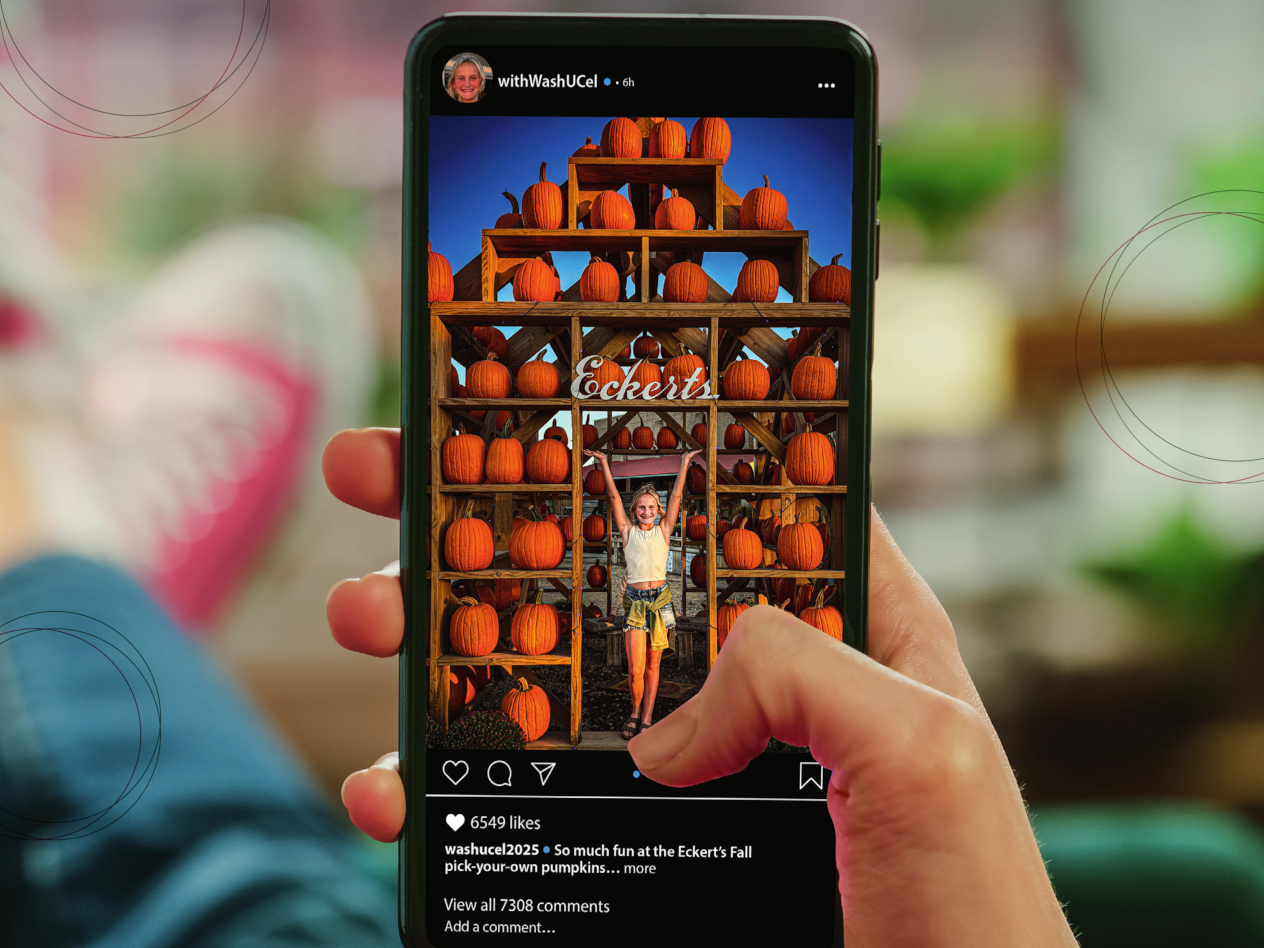
In recent years, they’ve noticed a social media-driven trend hitting their bottom line: younger visitors looking for a free photo backdrop, not baskets of fruit. Eckert’s sought out WashU Olin’s expertise, ultimately engaging student consultants with a finger on the pulse of their peers.
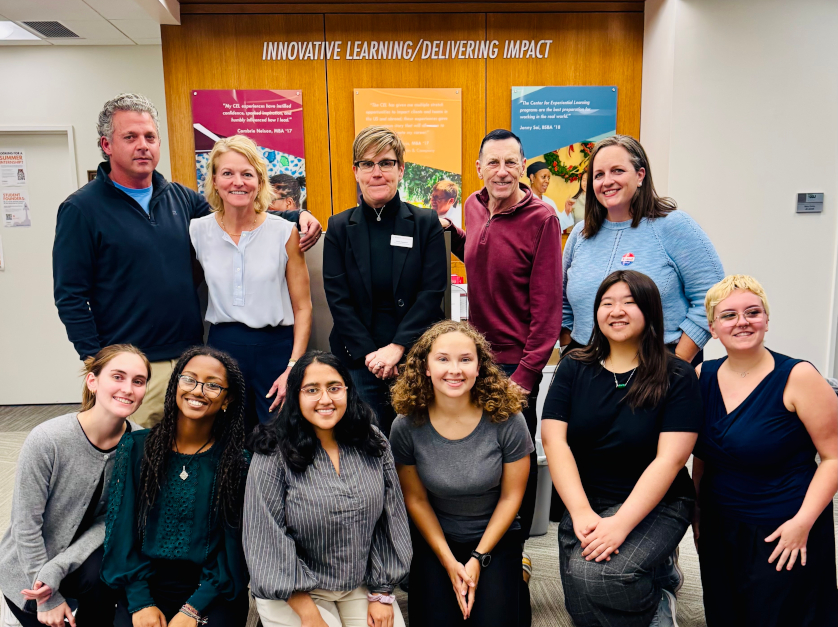
Olin’s Center for Experiential Learning (CEL) proved to be the right resource to help Eckert’s crack the code on reaching the Instagram- and TikTok-focused Gen Z consumer. The CEL took on Eckert’s as a client for an undergraduate-led, four-week competitive consulting challenge.
That model — short and impactful, organized mid-semester — is an example of the CEL’s new emphasis on agile, tailored experiential learning opportunities. The center’s strength has always been a hands-on approach that puts students to work solving real-world problems for businesses. Now the CEL is supplementing its traditional, 16-week academic course construct with ones that play out over four weeks or seven weeks.
Regardless of length, all CEL courses offer academic credit. Each project is finely tuned to meet the needs of a particular student or client. “The idea is that students can come to us and say they want to do something, or one of our partners can come to us and say they have a specific need, and we now have more flexibility to activate in those situations,” said Olin faculty Michael Wall, who also serves as academic director of experiential learning and curricular advancement.
The new course formats give businesses the benefit of student assistance without requiring months of collaboration. Meanwhile, students have greater access to projects that speak to their own passions and desired career paths.
Wall is excited about an approach that he said Olin is uniquely positioned to offer.
“Most schools can’t offer this kind of flexibility — their operating models are too large or too rigid, or they lack the infrastructure required to deliver,” he said. “Olin’s size, structure, faculty, and Center for Experiential Learning make it possible.”
“What makes this transformative is the differentiated and impactful learning experiences it creates,” Wall said. “For our students, it means opportunities they can’t find elsewhere, and for our partners, it delivers insights and outcomes that truly matter.”
For businesses like Eckert’s, it’s an invaluable opportunity to gain beneficial insights from Olin’s talented and motivated students — at the speed of business.
I was just blown away by the quality of WashU students. It was powerful, and it was also exciting to see the energy they put into it. The level of feedback and detail that we got was much more complex than I had anticipated.
—Angie Eckert, vice president of retail operations for Eckert’s Farms
Support for St. Louis businesses
The Eckert’s project, which grafts together WashU’s “In St. Louis, For St. Louis” ethos and a strategic focus on the individualized student experience, grew out of a COVID-era collaboration.
At the outset of the pandemic in 2020, Erin Joy, an entrepreneur and business consultant, had put together a task force to help St. Louis-area small businesses grapple with thorny issues such as masking, social distancing, and evolving government safety guidelines.
Looking for a professional economist with substantial business experience, she connected with Glenn MacDonald, John M. Olin Distinguished Professor of Economics and Strategy at WashU Olin. MacDonald said that as he reviewed the challenge facing the task force, he knew the group needed an infusion of business expertise.
“So, I met with a couple of my best students and found about 70 undergraduates from all over WashU, and I organized them into teams,” MacDonald said. “We did consulting projects with a collection of St. Louis small businesses, mostly task force members.”
One of those clients was Eckert’s. “Those who invented the (pandemic) distance restrictions had no idea that they might be applied to something like an apple-picking business,” he said. “My students figured out how to run Eckert’s in a way that would be safe and consistent with the rules but still allow them to sell apples and run a grocery store.”
Since that time, Joy has continued to bring some of her local clients to MacDonald for student consulting projects, supplementing similar experiential projects from national companies that he assigns to his classes. Most are notable for their speed: often a matter of a few weeks from challenge to finished proposal.
MacDonald has been following this format for a decade or more.
“We work really hard, like in a consulting company, for two or three weeks, and then present our recommendations and implementation plans,” MacDonald said. “The projects are not rushed — they simply occur at a pace that’s different from what would normally arise in an academic setting, which is very slow. A typical business pace — which students find themselves in soon after graduation — is much faster.”
WashU Olin's CEL In Action
Growing out of WashU’s “In St. Louis, For St. Louis” ethos, students from the Center for Experiential Learning recently partnered with Eckert's Family Country Farms, reviewing challenges and delivering solutions.

Experiential learning in motion
Since Wall took the academic reins at the CEL, one of his priorities has been to expand the universe of how Olin provides experiential learning opportunities to students, an outgrowth of Olin’s emphasis on individualized student learning experiences.
He said the new course constructs, which debuted this fall, add a fresh dimension to the options available to students and to the school’s business partners.
“Other course offerings are bound to the constraints of the academic calendar—known and planned for in advance of enrollment,” he said, noting that new constructs can be activated within the semester, giving students and partners greater flexibility.
“We have a wide range of experiential learning offerings with great breadth and depth, and they deliver incredible impact for our students,” Wall said. “What these new constructs add is another layer, enabling even more individualized opportunities that aren’t possible within our standard course formats.”
To test-drive the new model, the CEL and MacDonald partnered to pilot a “strategic sprint,” a three-week project in which teams competed to craft a solution for a client.
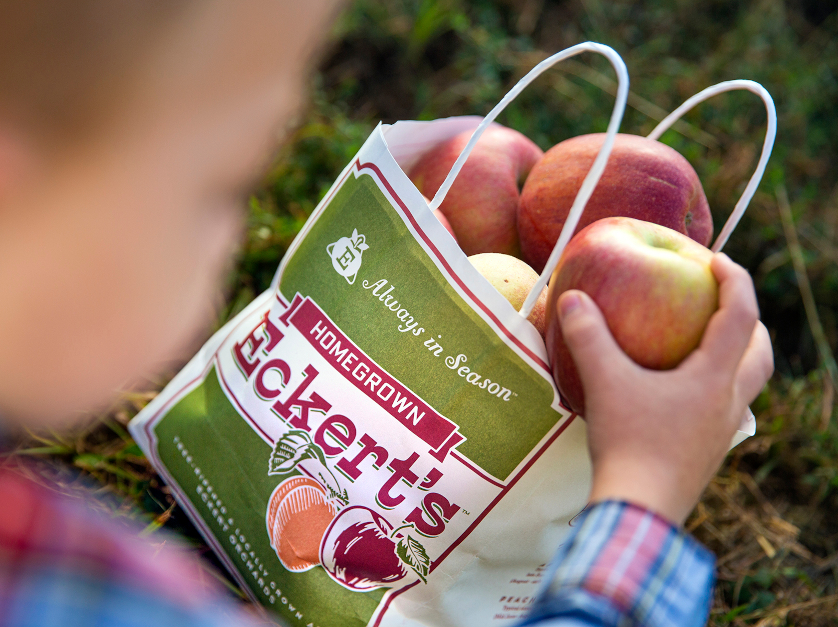
That client was Eckert’s, a sprawling farming operation whose Belleville complex features a restaurant, specialty food store, and garden center, plus seasonal locations in southern Illinois and Kentucky. Together, the various locations offer harvest-your-own opportunities for everything from spring strawberries and summer blackberries to fall pumpkins and cut-your-own Christmas trees.
Over the years, the family has made changes and additions, including the Cider Shed, an outdoor music venue serving food and drinks, which opened in 2022. Angie Eckert said the leadership team has been looking for ways to enhance the visitor experience in response to the changing trends they were seeing.“When my grandma came out here and picked, she picked bushels,” Eckert said. “Now, people come and take a picture and pick four apples. So we were asking, ‘How do we either get more guests here or dial up the experience around picking those few apples?’”
MacDonald said he’d been speaking with Wall for a while about the CEL pursuing more streamlined projects. When Wall began his new role at the CEL, MacDonald brought him the Eckert’s project.
They designed the sprint to kick off in late March and wrap up in early April, allowing the business to implement ideas in time for prime strawberry-picking season. The CEL invited teams of students to compete for a cash prize, with four teams eventually making presentations to Eckert’s senior leadership.
MacDonald said the winning team focused on finding ways to organize Eckert’s many varied activities into a more cohesive visitor experience.
Among the students’ recommendations were ideas to enhance the pick-your-own experiences for younger visitors, who place a high emphasis on social media posting. They suggested creating more photo opportunities in areas patrons must pay to enter, rather than in the free-admission parts of the farm.
Angie Eckert said the student consultants also suggested changes to how events are presented on Eckert’s website and social media, emphasizing the many different ways to serve fruit.
The appeal of the winning presentation was that Eckert’s could implement it quickly and easily, she said. They created ticketed areas with props set up for photos in the pick-your-own strawberry fields.
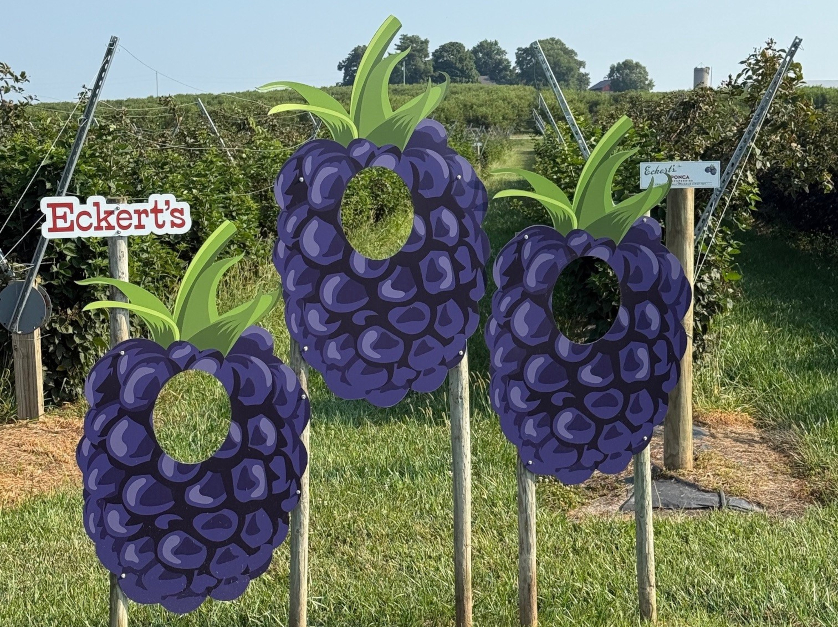
“After the students’ presentation, we invested in some interactive photo scenes,” she said. “We added three things to the strawberry patch: a strawberry cut-out, a swing, and a tandem bike.”
Later in the season, Eckert’s included donuts and cider in the strawberry fields as part of the ticketed experience. “The students definitely gave me the confidence to try it,” Eckert said.
The farm has continued to repurpose the photo props, moving the swing and bike to other fields for the sunflower and blackberry seasons.
Experiential Learning In Motion
Since Olin faculty member Michael Wall took the academic reins at the CEL, one of his priorities has been to expand the universe of how Olin provides experiential learning opportunities to students, an outgrowth of Olin’s emphasis on individualized student learning experiences.
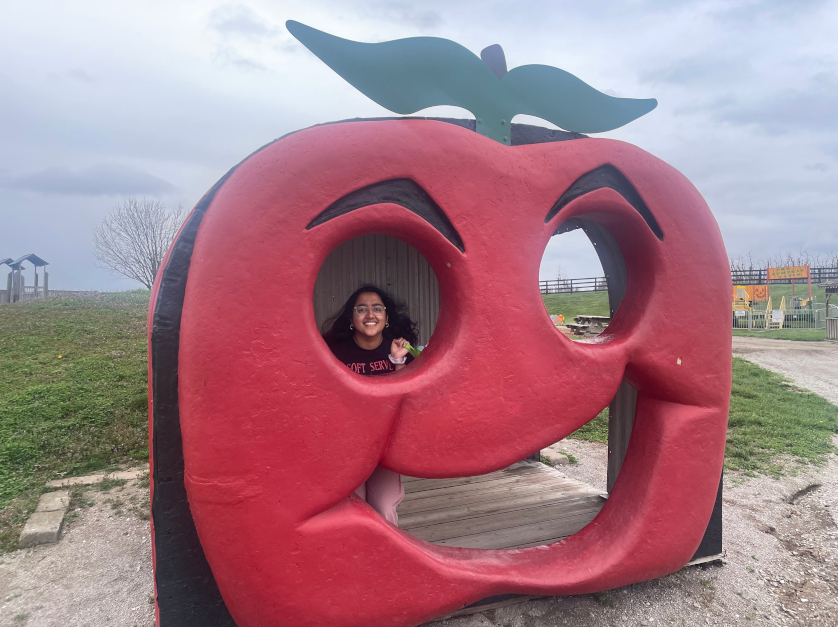
While the farm’s apple orchards are not currently set up well for photo ops, Eckert said the business is working on a new orchard planting design that could accommodate them. “To be continued on that!”
She added that the other competing teams also presented great ideas, ones she would like to see the farm implement in the future.
Ananya Radhakrishnan, and Jamie Nicholson, both BSBA 2025, were part of the four-person team that won the challenge.
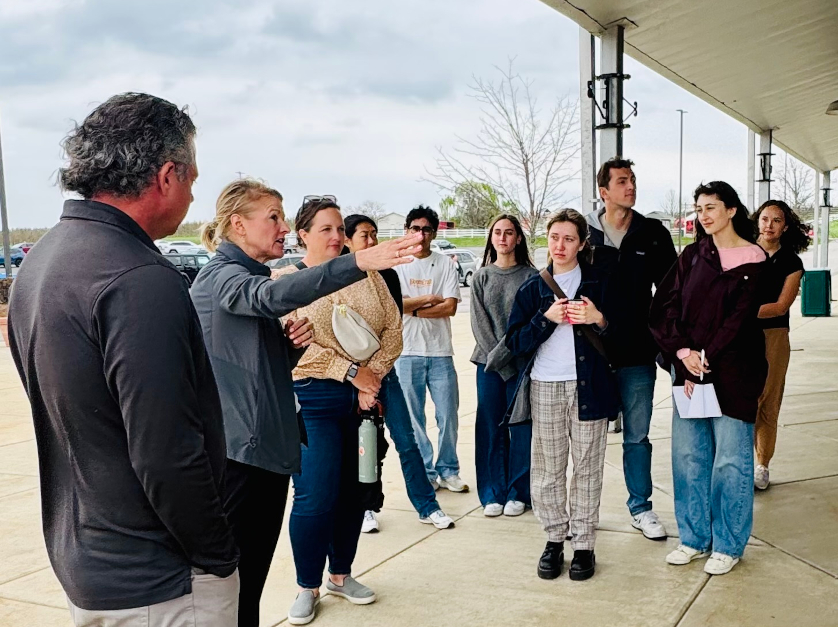
Both said they benefited from the opportunity to work directly with the owners as they created their recommendations. The students in the sprint had multiple meetings with the Eckert’s team, including a visit to the Belleville farm.
“I really enjoyed the relationship-building with the client, and I think it was really helpful throughout the process,” Radhakrishnan said. “So it was a skill I learned, but also something I really enjoyed doing.”
Nicholson said the Eckert’s strategic sprint and other experiential learning projects at Olin gave her valuable experience in the client consultation process, from initial meetings to final presentations. She has taken that experience to her new role as an associate consultant with Bain & Co.
“I got a ton of experience in learning about new industries and breaking down business models and examining them from the top level,” Nicholson said. “As well as working with a team and making recommendations that are as specific as possible.”
MacDonald said experiential learning opportunities like this one hone students’ skills and ultimately help them see that they are well prepared for entry into the business world.
“Learning in an academic setting is very efficient, but, by its nature, quite passive,” he said. “I give you an assignment, you do the assignment, I grade the assignment. Once they are ready for a more experiential approach, they can really go out, use their brain, and solve a problem.
“They always say the same thing: ‘Wow! That was so empowering. I feel like I can do something!’”
Bridging academics, experience, and community

Wall said the course constructs were designed not just for flexibility, but for credibility, expanding the range of individualized opportunities while upholding Olin’s academic standards and WashU’s accreditation requirements.
He credited Paige LaRose, senior associate dean and director of undergraduate programs, with helping to structure the programs to ensure they meet those standards. “We have the flexibility to be highly individualized without sacrificing academic rigor or jeopardizing university policy or accreditation,” he said.
The new courses are open not only to Olin students, but to students from across WashU. A second eight-week pilot conducted alongside the Eckert’s project included students from Olin, the McKelvey School of Engineering, and the Sam Fox School of Design.
Regardless of the students’ background, Wall said these experiences are most impactful as part of a deliberate learning journey. “Students first need the breadth and grounding of the core (courses), then building depth through electives, and only after that are they ready to bring it all together through experiential learning,” he said. MacDonald said it’s also essential to pair student teams with the right type of client — a business large enough to have substantial issues to work on, but small enough that the decision-makers can be actively involved with the students.
“Eckert’s was perfect — the students got to hear their clients, Angie and Chris, say, ‘That’s an awesome idea; I think I’ll do that.’”
Joy sees these partnerships as a vital bridge between WashU and the St. Louis small business community.
“A lot of small business owners have informal education; WashU can seem like the ivory tower,” she said. “This really does break down the walls. Business owners have direct access to Olin Business School and to WashU at large. They’re on campus, they meet professors, they meet the students. It really does create a palpable connection.”

Highlights Report: Individualized Education
-
CURRICULUM:
Launched 12 MBA specializations and 3 new specialized master’s degrees. -
EXPERIENTIAL LEARNING:
• Engaged 689 students in 135 Center for Experiential Learning projects.
• 4 out of 5 BSBA students complete an experiential learning credit. -
ENGAGEMENT:
Established the Koch Own-Operate-Invest Fellowship, with an inaugural class of 10 second-year MBA fellows receiving education, mentoring, hands-on experience, and networking support. -
PROFESSIONAL PROGRAMS:
Launched more individualized fulltime MBA and Flex MBA curricula, with 50% or more credits coming from 100+ elective courses.
About the Author
Suzanne Koziatek
Media inquiries
For assistance with media inquiries and to find faculty experts, please contact Washington University Marketing & Communications.
Monday–Friday, 8:30 to 5 p.m.
Sara Savat
Senior News Director, Business and Social Sciences