The Business of Health: A One-Year Checkup
- December 31, 2025
- By Suzanne Koziatek
- 8 minute read

One year in, the Olin initiative delivers fresh ideas, vital connections, and a fast path to progress.
The Business of Health — Olin’s ambitious initiative that seeks to engage and empower business leaders so they can improve the well-being of individuals and societies through health products, services, and community partnerships — has come a long way in 12 months.
Guided by a vision to create impact that can be felt across WashU and the St. Louis region, the initiative has rapidly scaled. It’s now a fully-fledged ecosystem of classes, programs, and partners geared toward educating future health leaders, engaging St. Louis’ deeply established healthcare community, and catalyzing investments that drive innovation.
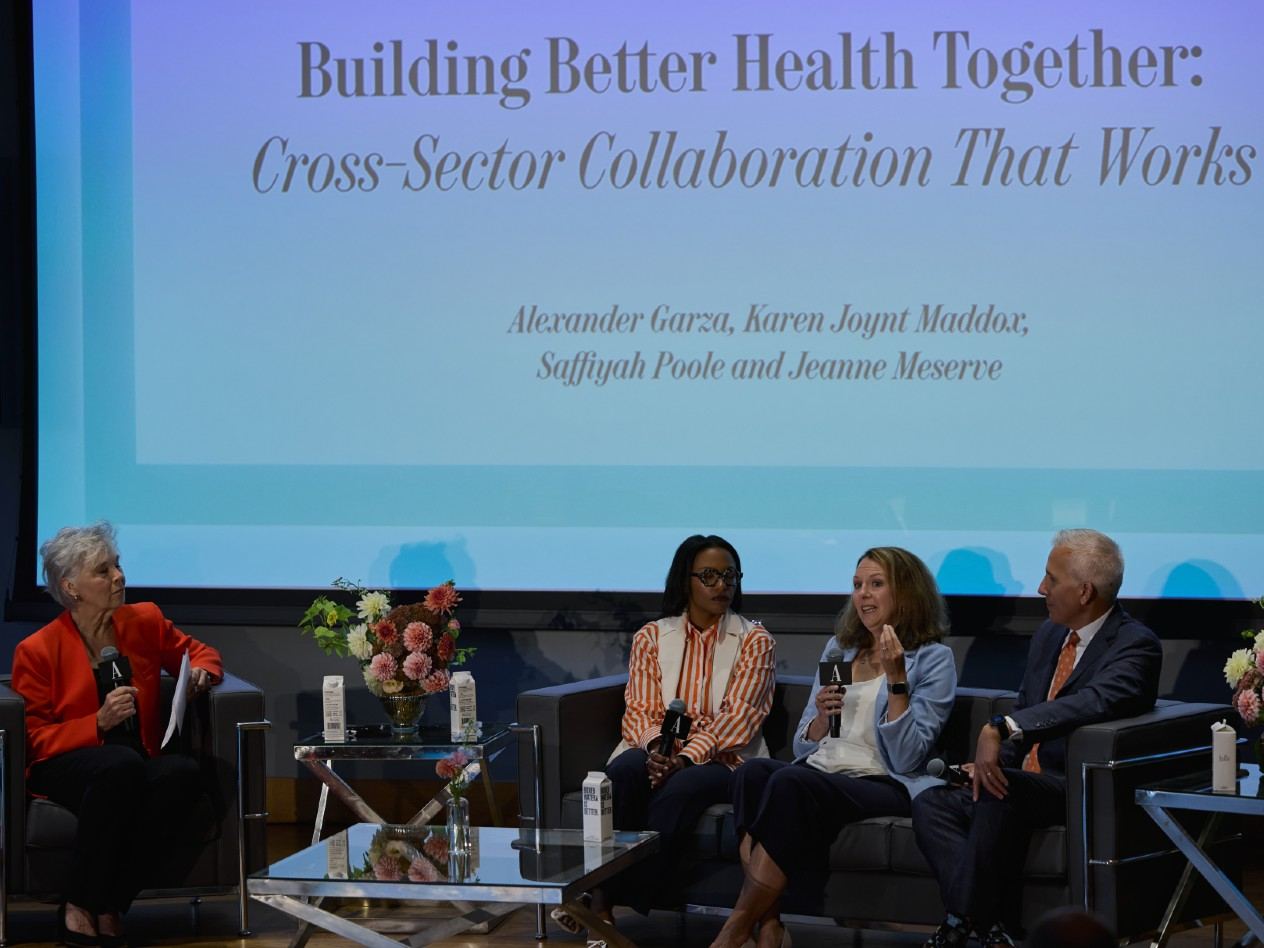
That impact was evident in October, when the school partnered with The Atlantic magazine for an event at Knight Hall to explore how science and business working together can propel medical breakthroughs from discovery to real-world impact at scale. It brought a national focus to the leading role that WashU and St. Louis play in this vital sector.
Speakers from the worlds of translational science, public health, and biotech entrepreneurship examined the crucial handoffs required for health innovation between research, implementation, and commercialization.
The speakers and panelists dissected the challenges that stand in the way of advancements, including sustained funding along the path to approval, bureaucratic roadblocks, and equitable access to innovative treatments.
The key, panelists agreed, was the power of collaboration. “Innovation, especially in the healthcare space, is a team sport,” said Olin alumna Erin Scott, MBA/MSBE 2007, PhD 2013, now a senior lecturer at MIT Sloan. “We want to bring people with deep knowledge across many different disciplines together in the room to move these innovations forward.”
The event highlighted the catalyzing role that universities can play in building bridges from innovators to funders and from startup to scale-up. That discussion is a microcosm of the role that WashU Olin is already playing in the sector, Olin Dean Mike Mazzeo said.
We’re bringing core business skills to fuel the steady growth of ideas and innovation, so that we can build better outcomes for patients, improve care delivery systems, and deliver revolutionary breakthroughs to the market.
—Mike Mazzeo, Dean, Olin Business School
Building academic momentum
In classrooms across Olin and throughout WashU, faculty are introducing courses that tackle the economic, financial, and management challenges of health. The school has introduced a new MBA specialization and a health designation in the Executive MBA program, bringing the number of health-focused degrees at Olin to six. (The other degrees include a BSBA in Healthcare Management, an MS in Business Analytics with a Healthcare Analysis concentration, and joint MD/MBA and MBA/MPH degrees.)
This year, the school welcomed two new faculty members who work and teach in this field: Ryan McDevitt, a professor of economics, and Arlen Dean, an assistant professor of supply chain, operations, and technology.
McDevitt said he was drawn to Olin by Mazzeo’s vision for the school, particularly the role of the business of health.
“I think WashU is poised to be the top university in the world for researchers who want to make an impact, not just as academics, but in terms of advocating and advancing health business and policy as well,” he said. “There’s no better place to be doing what I’m doing.”
He’s excited about opportunities to collaborate with colleagues across WashU. “Before I even set foot in St. Louis, I was on Zoom calls and having email threads with faculty in the Medical School and the School of Public Health.”
6 Health-focused degrees at WashU Olin
-
MBA with a Business of Health specialization
-
MBA with a joint MD degree from WashU Medicine
-
MBA with a joint MPH from WashU Public Health
-
MS of business analytics with healthcare analytics concentration
-
Executive MBA with health designation
-
BSBA in Healthcare Management
Olin is collaborating to provide cross-pollinated courses that draw from the strengths of all three schools. The WashU Medicine ties are long-standing; for example, for more than 15 years, Olin has collaborated on an “Olin Grand Rounds” course focused on the business of medicine.
The ties to the newly launched School of Public Health are already starting strong. Inaugural Dean Sandro Galea joked that learning about Olin’s health initiative as he prepared to join WashU was his “sign me up” moment.
“Hearing that Olin had this vision for a Business of Health initiative seemed to be a perfect moment to launch such a vision in parallel with the university investing in a School of Public Health,” Galea said.
A supportive, health-focused learning environment
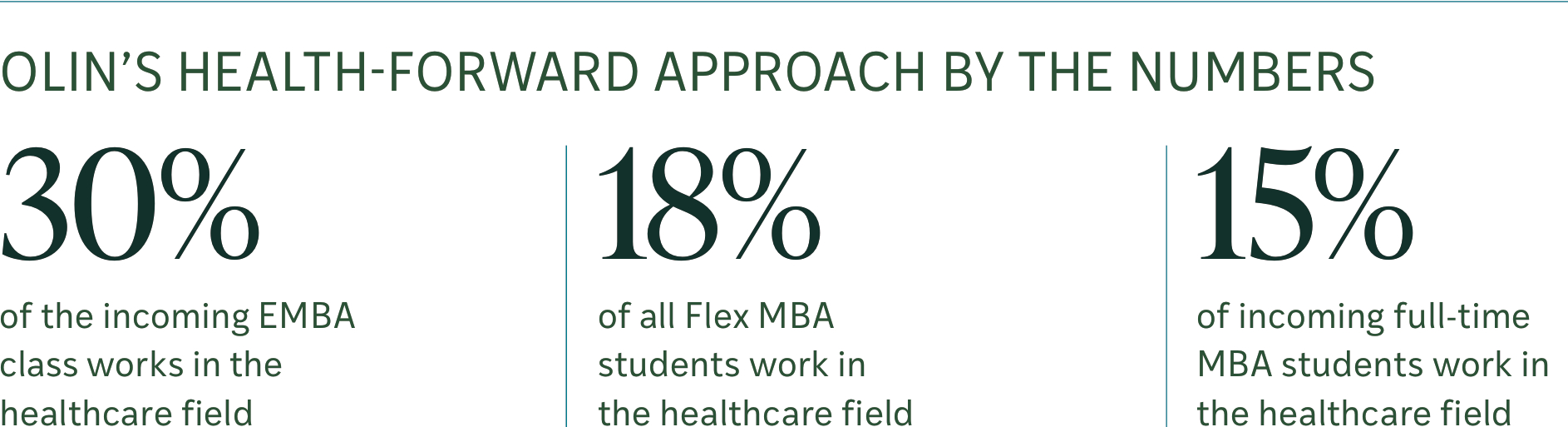
Olin’s health-forward approach continues to attract a substantial number of healthcare professionals into the school’s graduate programs: 30% of the incoming EMBA class, 18% of Flex MBA students, and 15% of incoming full-time MBA students work in the field.
Lakshmi Gokanapudy Hahn, a pediatric transplant cardiologist and associate medical director of the heart transplant program at St. Louis Children’s Hospital, is in her first year of the EMBA program.
Discussions with Patrick Aguilar, Olin’s managing director of health, convinced Hahn to accelerate her plans to pursue her Executive MBA.
“Initially I was thinking about doing it next year,” Hahn said. “But I chatted with Patrick, and as he told me more about the Business of Health, it seemed so juicy — like, this is exactly why I want to do this. I thought, ‘Why am I waiting? I’m just going to start.’”
She said she’s already applying what she’s learning to her current job, as well as gaining insights about her future path. “It really broadens my horizons as to what my impact could really be,” Hahn said. “I’m looking forward to seeing what roles I could potentially take on.”
As Rony Takchi began his EMBA studies in 2024, he was looking to transition from a medical research role at WashU to a business-focused position. He found strong support through Olin, including guidance from Aguilar.
“I needed help to figure out what my other options were,” Takchi said. “Patrick was a very good resource for me. He was very supportive throughout the entire process.” Takchi recently accepted a position with Geneoscopy, a gastrointestinal health startup co-founded by a WashU Medicine graduate.
Olin’s leadership in entrepreneurship has long attracted health-focused students with innovative ideas. The school joined with Poets & Quants to host a Big IdeaBounce competition focused on health innovation, drawing applications from 75 young entrepreneurs from 50 schools in 10 countries. Among the finalists was Olin’s Sergiu Celebidachi, whose SPARC Sports app uses AI to help student athletes prepare mentally. Since then, Celebidachi, MBA 2025, has been named a St. Louis Inno under 25 honoree and made the top tier of a national pitch competition.
“The classes I’ve taken as a student were very entrepreneurship-focused,” Celebidachi said. “They boosted my entrepreneurial experience and pushed the needle forward on the business as well.”
As leaders climb the career ladder in healthcare organizations, Olin executive education offerings, such as advanced management certificates and custom programs, can help them level up their strategic skills. Rob Goren, president and CEO of Delta Dental of Missouri, said his Olin executive education experience helped him settle smoothly into his leadership role.
“As a new CEO in 2015, our board of directors knew that I brought a strong financial acumen to the role but wanted to ensure that I also immersed myself in the latest training in talent management, strategic thinking, business execution, and leadership,” Goren said. “The advanced management certificate program allowed me to sharpen my skills and lead more effectively over the past decade.”
Leading the conversation about health
Professors at Olin are driving discussions about the most pressing issues in health, not just in classrooms, but through research and in forums aimed at the business community. Aguilar has begun a series of “Health Decoded” seminars — open to students and alumni — in which he invites business and health leaders to dissect the real-world challenges they’ve encountered, and the solutions they’ve found.
An emerging area of focus for several Olin faculty has been how the ownership of healthcare organizations can affect patients. Aguilar has written about the impact of private equity ownership on the Walgreens pharmacy chain and on care of heart failure patients. Similarly, McDevitt has studied the effects of consolidation on the dialysis industry and is interested in how private equity ownership affects care.
New health-focused professor Arlen Dean studies ways to manage resources to optimize hospital operations, as well as medical decision-making and disease progression. Dean is eager to collaborate with colleagues across the university. “There are so many researchers in different areas — public health, computer science, statistics, clinicians — focused on these issues,” he said. “In terms of connections and resources, it’s quite abundant.”

Building a network for business impact
A key focus of the initiative is to draw together academic researchers from across WashU and spark conversations about how to build networks to solve problems, advance innovation, and drive business outcomes.
Joe Beggs, BSBE 2020, alumnus of WashU’s McKelvey School of Engineering, and founder/CEO of healthcare company GenAssist, got a taste of this synergy at Olin’s business of health spring research symposium.
“I thought I was just going to be listening to talks, but we actually had an opportunity to talk to each other and to bring up what we’re working on and what could help supercharge our own innovations,” Beggs said. “I came away from that with multiple potential collaborations and that’s not something I had when I walked in the door.”
That continued emphasis on connectivity is key to the value WashU Olin brings to the business of improving health across society.
“When we start to collaborate, we get insights on opportunities, gaps, and policy needs that we would miss if we stayed in our own silos,” Aguilar said. “When we collaborate, we get new tools for operational leadership that help us optimize, improve, and sustain care delivery. And ultimately, that's how we get solutions.”

Highlights Report: Business of Health
-
FUNDING:
Established $5 million Kent Catalyst Fund to scale the Business of Health initiative. -
CURRICULUM:
Launched new Business of Health MBA specialization that connects academic business concepts to the nuanced problems healthcare organizations face. -
FACULTY:
Welcomed two new faculty members conducting high-impact health research. -
COMMUNITY ENGAGEMENT:
• Partnered with The Atlantic to bring new insights and perspectives to the discussion.
• Established monthly Health Decoded case study discussions with industry leaders.
Business of Health in Action
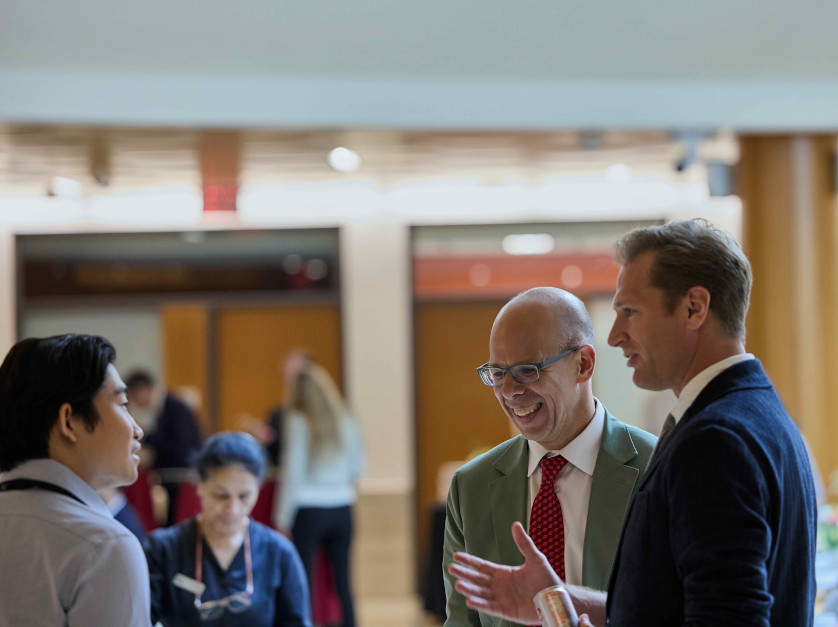
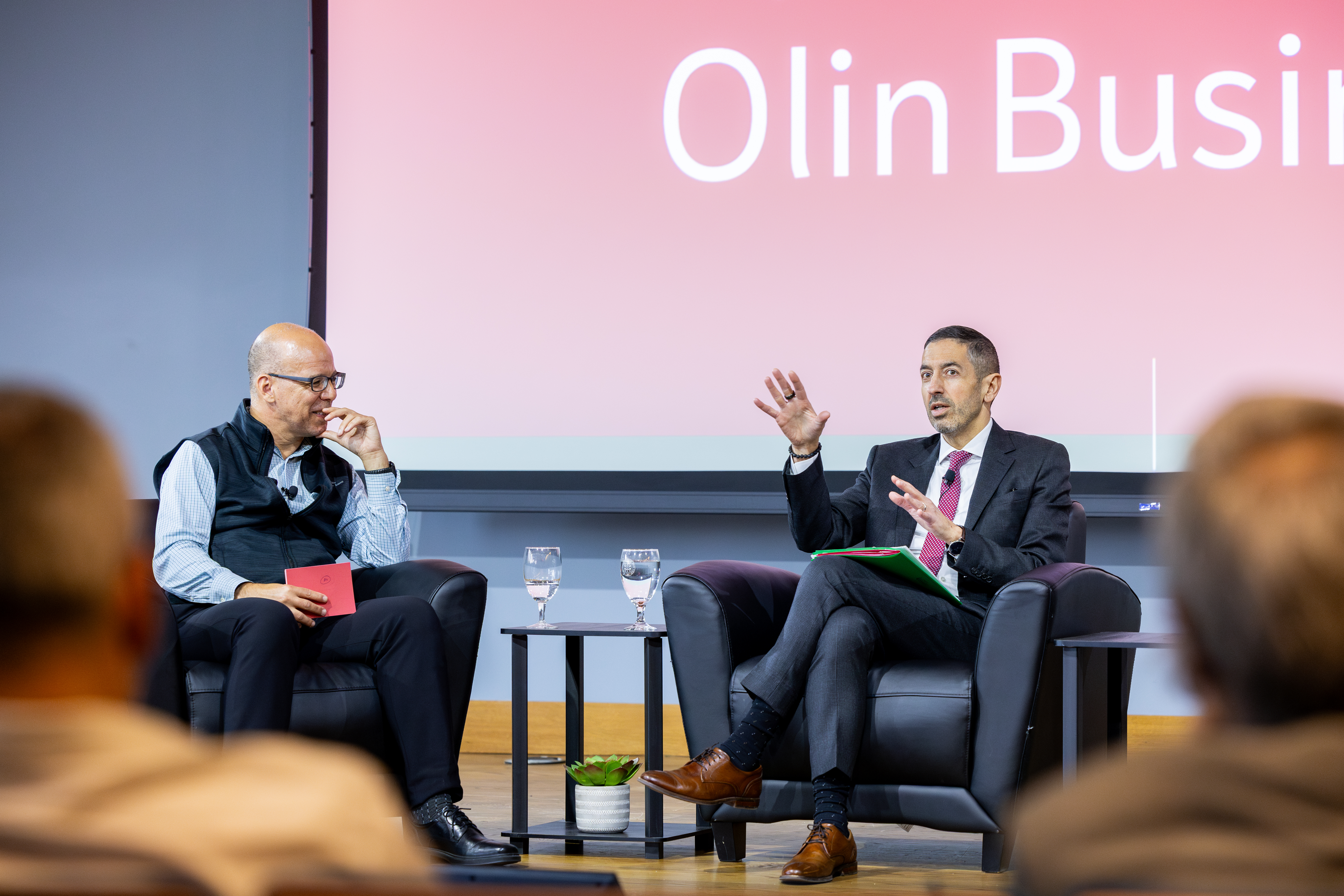
From academia to industry, the room was filled with changemakers driving collaboration.
About the Author
Suzanne Koziatek
Media inquiries
For assistance with media inquiries and to find faculty experts, please contact Washington University Marketing & Communications.
Monday–Friday, 8:30 to 5 p.m.
Sara Savat
Senior News Director, Business and Social Sciences