Koch Center mentor gains insights as he gives back to Olin
- January 14, 2026
- By Suzanne Koziatek
- 4 minute read
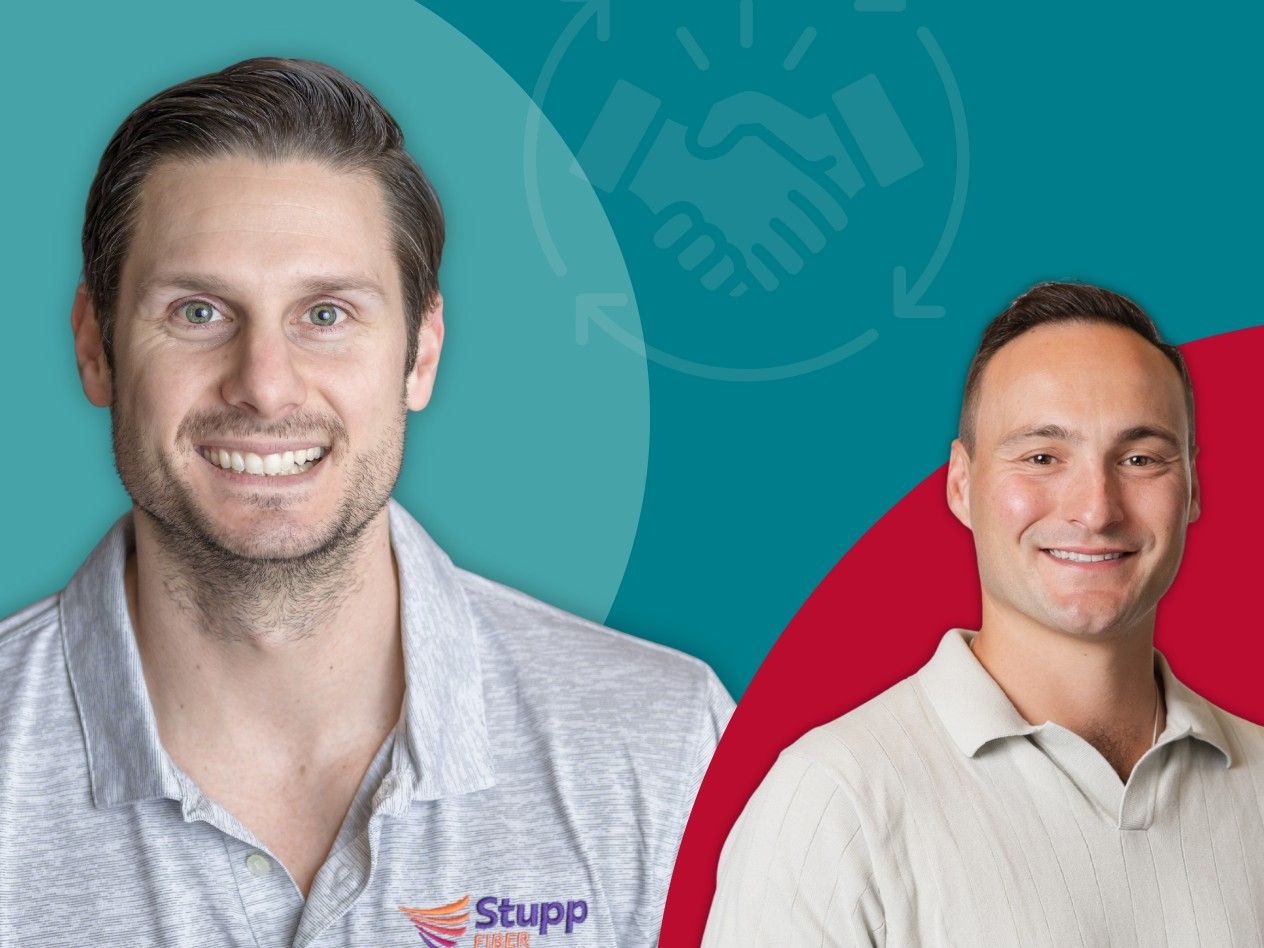
The Koch Center for Family Enterprise’s Own-Operate-Invest Fellowship guides Olin students who aspire to entrepreneurship through acquisition or running a family business.
The fellowship program pairs students with seasoned industry leaders who mentor them, offering advice and serving as a sounding board as the students make decisions about their futures.
For mentors like John Stupp III, MBA 2015, president of Stupp Fiber, the experience isn’t just an act of altruism — he finds it professionally rewarding as well.
Stupp noted that his family’s 169-year-old company, Stupp Bros., Inc., is in its sixth generation.
“There are many long-standing procedures, practices, and governance structures,” he said. “Over time, that can create a narrowing effect where exposure to new and innovative ideas and perspectives becomes limited.
“In working with these students, I've been able to see the theoretical side of new teachings, as well as learn from their past corporate experience, some practices that are beneficial for us to consider.”
Stupp’s ties to the Koch Center are foundational — as a first-year MBA student, he led the development of a feasibility analysis for a proposed curriculum offering in family business. That work helped inform the creation and structure of the Koch Center for Family Enterprise.
“It was something the university had been interested in for a long time, with many strong stakeholders helping bring the topic forward,” Stupp said. “I think I was just the final push that helped to get the momentum moving forward.”
In working with these students, I've been able to see the theoretical side of new teachings, as well as learn from their past corporate experience, some practices that are beneficial for us to consider.
—John Stupp III
Since then, he has continued to be involved with the Koch Center and more broadly with Olin and WashU, including serving on the Olin Alumni Board.
“My experience at Olin was incredibly enriching and helped me grow both professionally and personally. It also allowed me to build many meaningful relationships in both the corporate and personal worlds,” Stupp said. “As a result, I’ve felt a strong desire to give back to the university in any way I can and to support its growth alongside my own.”
Guidance on a career path
The Koch Center launched the Own-Operate-Invest fellowship in early 2025 to support students in their goal of becoming next-generation owners, operators, and investors through entrepreneurial acquisition or a family business.
The fellowship includes a financial stipend, networking opportunities, and practical experience with companies in those spaces. The mentorship pairings are an integral piece of the program, said the Koch Center’s director, Peter Boumgarden.
“One of the things that is unique and valuable about the fellowship program is allowing students to really go deep on vocational exploration with people in the community who share their interests,” he said. “For some students who will enter a family business, that is sitting alongside family business leaders who have walked in their shoes in similar challenges. For others, it is exploring the tactical side of getting into ownership through a purchase and learning from someone who has already pursued that work.
“There is a lot we can teach in the classroom, but this kind of one-on-one individualized learning through mentorship really makes the program sing.”
The creation of the fellowship and its mentorship program gave Stupp the opportunity to give back to the Koch Center in a way he finds personally fulfilling.
“Mentorship opportunities have been a key part of my career development,” he said. “Recognizing that, it's been a desire of mine to provide that to other students at the university.”
A valuable exchange
Over the course of the program, Stupp has worked with two mentees, most recently full-time MBA student Joe Renner. Renner is also navigating his experience in a family business, St. Louis-based National Real Estate Management Corp.
“He’s at a pretty pivotal point in his career development, and he's trying to take advice from somebody who's walked that path before,” Stupp said.
Throughout the semester, Renner said he and Stupp met every few weeks, usually over a meal or coffee. “I was looking for advice, someone to shoot ideas off and learn from.” They’ve discussed business plans, succession planning, and governance.
“He’s very thoughtful, detailed, and even-keeled,” Renner said of Stupp. “Navigating a family business can be complicated; there are often challenging dynamics involved. John has opened my eyes to the realities of that.”
Although Renner is slated to be paired with another mentor during the spring semester, he hopes to continue to connect with Stupp. “John and I have discussed staying connected after the program. He doesn’t treat mentoring like an obligation; he genuinely enjoys the process. Even if he isn’t my assigned mentor next semester, we plan to keep building the relationship.”
Stupp said providing his insights and experience doesn’t just help the individual students; it helps drive forward the overall practice of family business.
“Out of the total employment in the U.S., roughly 70% has some type of family business structure,” he said. “Yet, when you look at our education systems and consulting platforms, there's very little that is tailored specifically towards this large practice.”
Working with the Koch Center and with the OOI fellowship program, family business practitioners can expand knowledge about best practices and help advance the next generation of family business leaders.
“We all benefit from that,” Stupp said.
About the Author
Suzanne Koziatek
Media inquiries
For assistance with media inquiries and to find faculty experts, please contact Washington University Marketing & Communications.
Monday–Friday, 8:30 to 5 p.m.
Sara Savat
Senior News Director, Business and Social Sciences