Bauer Leadership Roundtable: Asking AI the right questions
- May 4, 2026
- By WashU Olin Business School
- 4 minute read
Christy Cox thought an AI agent would handle the heavy lifting as she evaluated candidates for an opening at St. Louis-based ARCO Construction.
She plugged in the job description, the candidate resumes, her interview notes — and asked which candidate was best suited for the job.
Then she hired the candidate the AI liked the least.
“And she’s absolutely killing it,” Cox said at the inaugural Bauer Leadership Roundtable Series on April 15, 2026. The event, entitled “Data Didn’t Do It: Why Understanding Numbers is Competency #1 in the Age of AI,” drew about 30 human resources and leadership development professionals.
The event was the first in a series of semiannual breakfast gatherings designed as collaborative forums where leadership and talent development professionals can network, share best practices, and learn applied, research-backed insights from Olin's faculty expertise and other thought leaders.
WashU is definitely a great resource to better understand the complexities of the St. Louis business culture and what’s happening in the research world.
—Christy Cox
The events showcase WashU Olin and its faculty as potential strategic partners with organizations seeking resources to map out leadership development plans for high-potential employees.
Asking the right questions
Cox’s story dovetailed nicely with the event’s keynote by Liberty Vittert, professor of practice in data science at WashU Olin. Vittert walked participants through a handful of real-world cases involving the interpretation of raw data. Her premise: AI won’t reveal sound insights from the data if users don’t ask the right questions.
In Cox’s hiring example, the AI’s favored candidate might have been perfect for what the job description called for. But the process led Cox to realize she wasn’t asking the right question. The job description she used wasn’t quite right for the job ARCO needed to fill. She went on to create a job description better reflective of ARCO’s needs.
In her talk, Vittert introduced cases such as a comparison of facial identification products that boast 90% accuracy. That conclusion is absolutely true, Vittert said, until you ask, “What do we really want to know about this data?” By teasing apart the data, we realize these systems are deeply inaccurate in the case of identifying dark-skinned females, for example.
Or, Vittert said, consider a mammogram that indicates a patient is 80% positive for breast cancer — a real example she confronted with her mother. A patient could be forgiven for assuming she is 80% likely to have cancer. But the better question, Vittert said, would be, “What’s my chance of having breast cancer if I have a positive test?”
Because mammography systems are calibrated to avoid the worst possible outcome — a negative mammogram in a patient who actually does have cancer — they overcorrect. That can lead to more false positives — a positive mammogram in a patient without cancer — which was the case with her mother.
The presentation helped participants realize that using AI to evaluate data doesn’t solve anything unless they’re careful to formulate the right questions. “It does have me thinking,” Cox said. “In this group of HR people, it has me thinking about those human elements. What can’t technology replace? It’s good food for thought.”
AI for leadership development
The forum also introduced the results of a survey by Stuart Bunderson, director of Olin’s Bauer Leadership Center and the George & Carol Bauer Professor of Organizational Ethics & Governance. Bunderson surveyed leaders from a host of regional organizations ranging from the St. Louis Cardinals and Panera Bread to Schnucks and MERS Goodwill to gauge their use of AI tools to promote leadership development.
The results showed that while more than half expected AI to influence their development efforts within three years, most remain in the early exploratory phases. Only about 4% reported actively using the tools. Fewer than 20% of surveyed leaders had a clear strategy or the internal expertise needed to put it in practice.
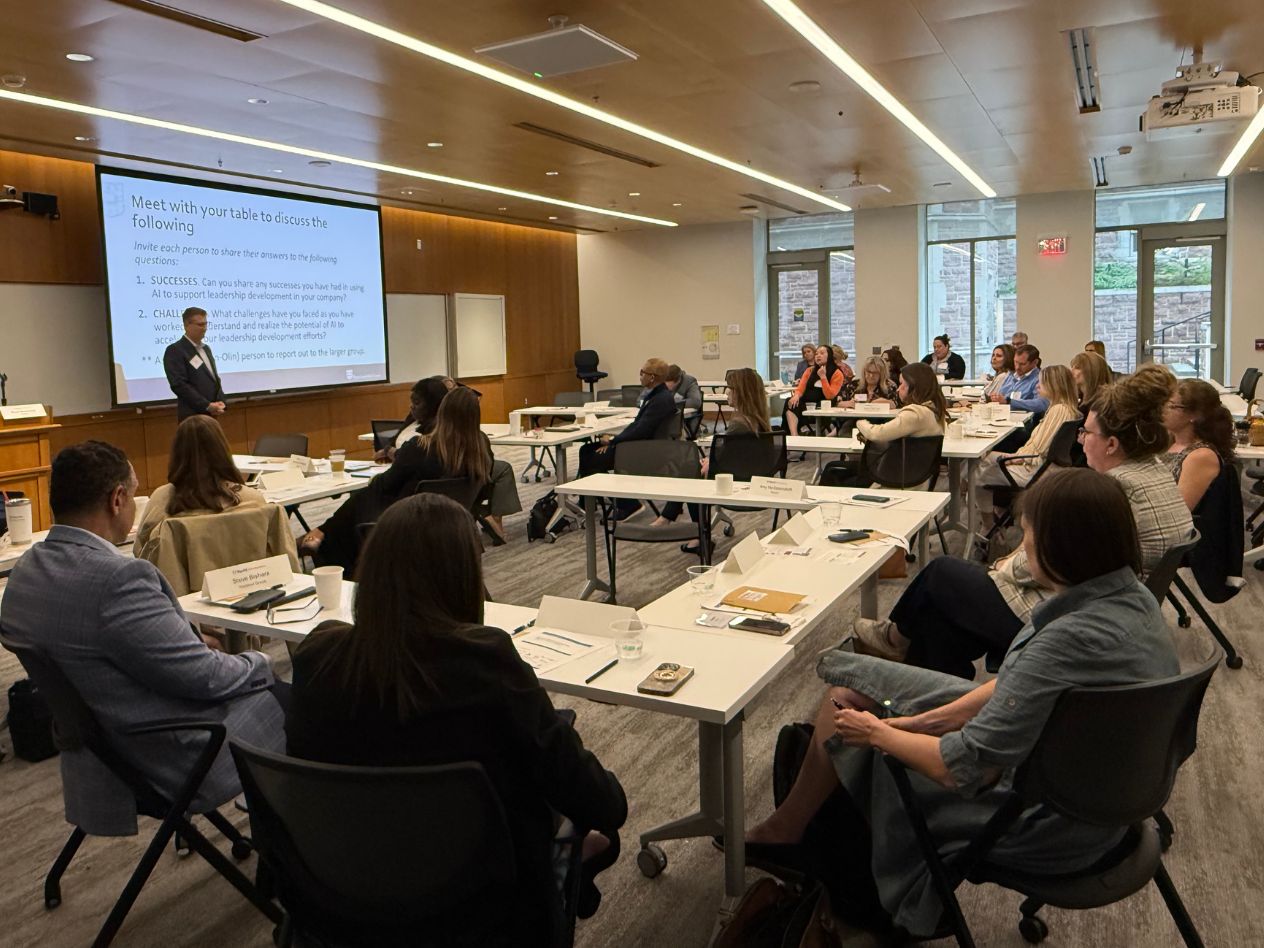
Bunderson concluded his session by encouraging participants at each table to discuss successes and challenges as they dipped their toes into using this technology for workforce development. “Already when people are looking for solutions to leadership development problems, people are turning to AI,” he said.
After the roundtable, Cox said she appreciated the perspective it gave her on what was happening in her segment of the business world.
“It’s nice to see people thinking about some of these real-world issues, how they apply in various contexts, and benchmark it with what we’re doing,” Cox said. “WashU is definitely a great resource to better understand the complexities of the St. Louis business culture and what’s happening in the research world.”
Photo caption: Stuart Bunderson, director of Olin’s Bauer Leadership Center, presented results from a survey about AI use for leadership development among major St. Louis area organizations.
About the Author

WashU Olin Business School
Media inquiries
For assistance with media inquiries and to find faculty experts, please contact Washington University Marketing & Communications.
Monday–Friday, 8:30 to 5 p.m.
Sara Savat
Senior News Director, Business and Social Sciences