EMBA alum leads geospatial nonprofit focused on AI innovation
- June 3, 2026
- By Suzanne Koziatek
- 4 minute read
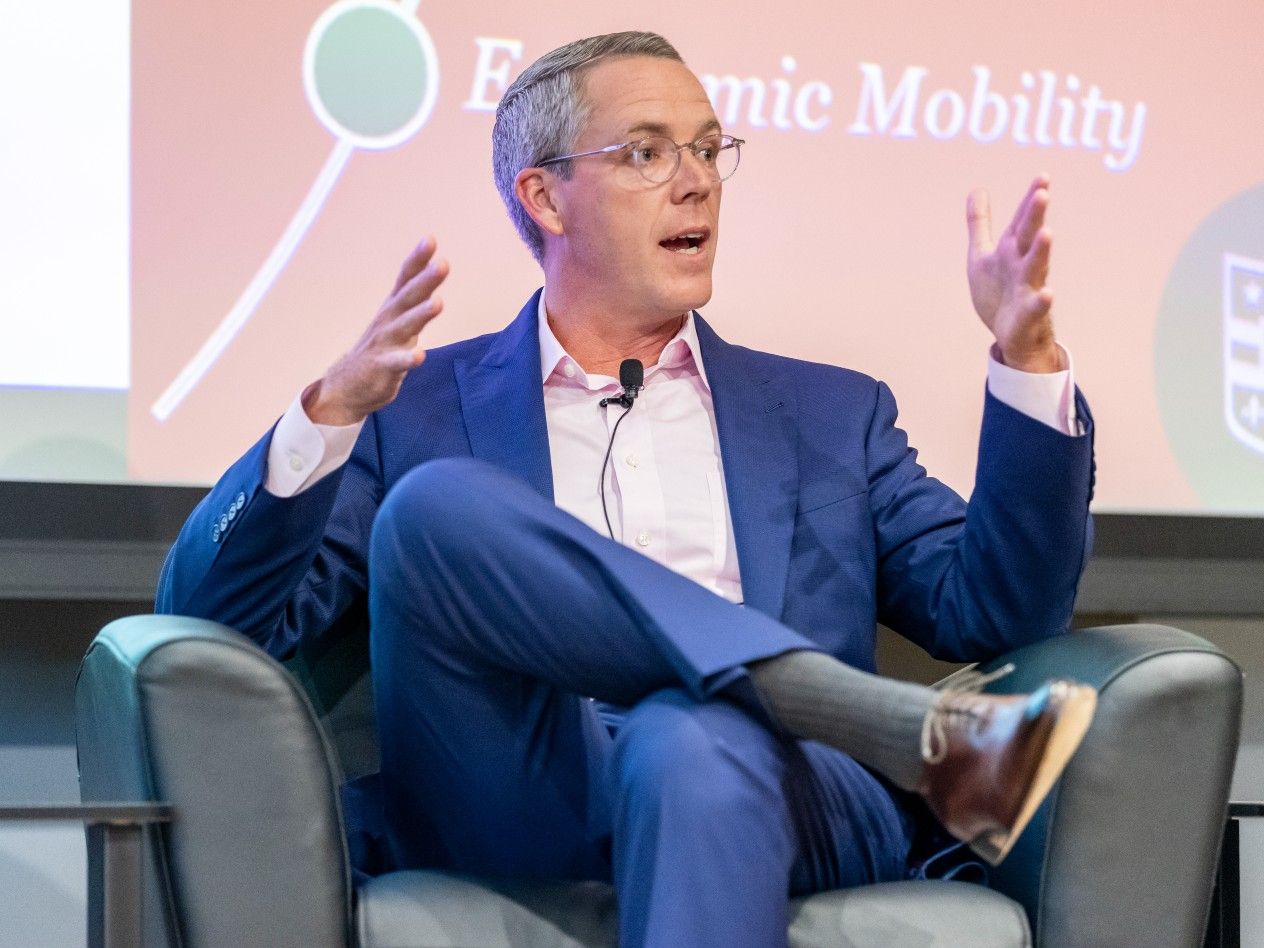
Elliott Kellner, EMBA 2024, has found his Olin education to be an invaluable tool as he leads his organization in navigating the uncharted territory of AI-fueled geospatial innovation.
In March, Kellner was named president of Taylor Geospatial, a nonprofit formed by the merger of the Taylor Geospatial Institute (where he had previously served as chief financial and operating officer) and the Taylor Geospatial Engine. Both organizations were funded by Andrew Taylor, executive chairman of Enterprise Mobility.
Kellner, who has a background in agricultural science and previously worked in both academia and at the Donald Danforth Plant Science Center, said the skills he gained through his Executive MBA helped build a bridge between his science background and the leadership roles he was taking on.
“I came up on the science side, and that fluency still shapes my perspective,” Kellner said. “But the question that’s defined my career is how we translate scientific discovery into durable impact — for communities, for industries, for the public good. What I’ve been able to add is the strategic and financial discipline that’s often the missing ingredient when great research needs to scale.”
Accelerating insights with AI
Taylor Geospatial aims to move technological breakthroughs in geospatial science from academic research to real-world use cases in a range of sectors — everything from defense and agriculture to public health and environmental resilience. In the past year, the focus in this field has shifted to applying artificial intelligence to dramatically accelerate the understanding and value of satellite data.
Kellner said hundreds of Earth observation satellites now deliver a continuous tidal wave of imagery — at every resolution and in volumes no analyst team could ever process by hand. All that information needs to be identified and sorted — what is a tree, what is a building, what is a flooded street, what is a convoy — before it can be useful to governments, businesses, and the public.
“We’re generating millions of images every single day — far more than any human workforce could ever review,” he said. “And traditional automation simply can’t keep pace with how quickly the data, and the questions we ask of it, are evolving.”
Enter geospatial AI: a new generation of tools that can churn through all the data quickly enough to provide real-time insights. “GeoAI is the defining market opportunity of this decade,” Kellner said. “The question is who builds it, and how.”
The (EMBA) program prepares you for the messiness of real leadership, not just the textbook version.
—Elliott Kellner
It’s a fast-evolving technology that many companies are seeking to be the first to dominate. Taylor Geospatial is taking a different posture — committed to an open-source, open-science pathway that democratizes the technology and establishes St. Louis at the forefront of that effort.
To get to that point faster, Kellner said the leaders of the two Taylor Geospatial entities — one focused on research, the other on commercialization — decided merging was the most effective path forward. He said his EMBA experience proved indispensable, from the initial strategic plan through the operational rebuild.
“We have rebuilt the organization from the top down,” he said. “Merging two entities is intensive change-management work in its own right, and we’ve done it while tripling our headcount in four months. That kind of pace only works if you’re disciplined about culture, structure, and the people you bring in.
“Every dimension of that work — finance, change management, organizational design, the internal and external politics — drew directly on my EMBA. The program prepares you for the messiness of real leadership, not just the textbook version.”
A shared goal for St. Louis
Kellner also drew on the relationships he’d built during his EMBA program, with other members of his cohort as well as other classes and faculty members.
He said the Olin influence has been especially meaningful because of Taylor Geospatial’s focus on moving St. Louis forward — a commitment that many of his classmates share. “What sets Olin apart is a shared commitment — across students, faculty, and alumni — to ask not just what’s possible, but what we owe this community,” Kellner said. “How do we deliver real, material benefit to the St. Louis region?
“The people I met at Olin — in my cohort and across others — were determined to contribute to this region. And when the opportunity didn’t exist, they built it. That’s the same opportunity I’ve found at Taylor Geospatial: the chance to build something this region, and this country, needs.”
As the geospatial ecosystem continues to grow in St. Louis, he hopes to see more Olin MBAs leading the way.
“Like any deeply technical industry, geospatial needs business leaders who can move between disciplines — people who understand the technology, the markets, and the public interest,” Kellner said. “That’s what Olin trains: strategic thinkers who see opportunity in complexity. And that’s what this field, and this region, needs more of.”
Photo caption: In April, Elliott Kellner participated in the Koch Center’s 11th Annual Family Enterprise Symposium. He discussed Taylor Geospatial’s work to solidify the St. Louis region as a global geospatial tech hub.
About the Author

Suzanne Koziatek
Media inquiries
For assistance with media inquiries and to find faculty experts, please contact Washington University Marketing & Communications.
Monday–Friday, 8:30 to 5 p.m.
Sara Savat
Senior News Director, Business and Social Sciences