Olin launches Executive Insights series with look at AI’s impact across industries
- October 20, 2026
- By Suzanne Koziatek
- 4 minute read
It’s easy to see how artificial intelligence can be a game changer in tech-focused fields like software engineering and data processing.
But as the models have evolved, use cases have sprung up across industries, including some that once might have seemed resistant to disruption.
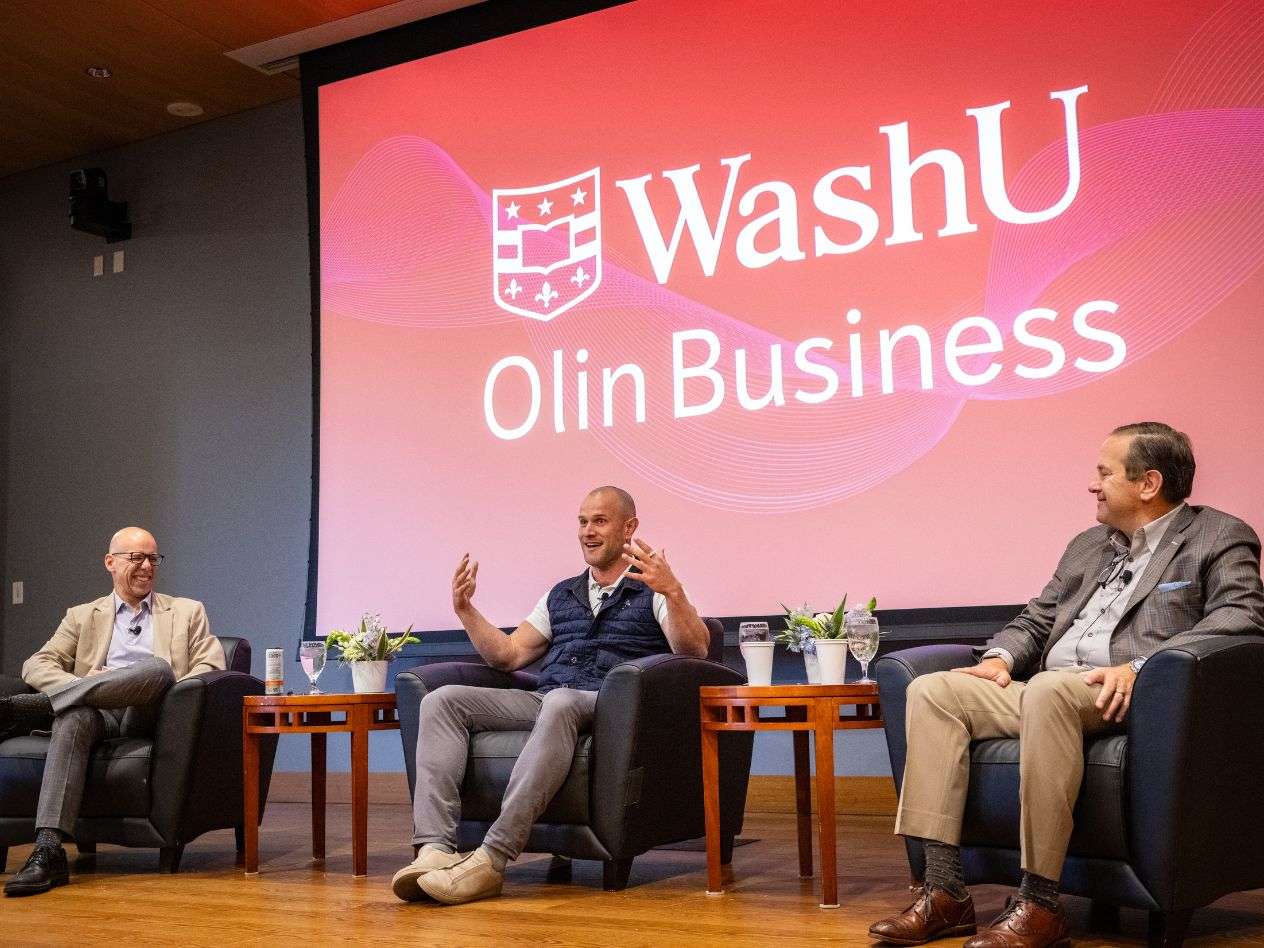
At the inaugural Executive Insights event at Olin, Dean Mike Mazzeo explored this dynamic with Olin alumni who are CEOs of companies that have incorporated AI into their organizations. The event launched Olin's new Executive Insights series, which will bring together business leaders, alumni, faculty, and corporate partners for timely conversations about the challenges and opportunities shaping business today.
The discussion, which drew more than 160 students, alumni, and corporate partners to Emerson Auditorium, highlighted Olin’s growing focus on the business impact of AI. With more than a decade of expertise in AI and its business applications, Olin is preparing the next generation of leaders to navigate an increasingly AI-enabled workplace while partnering with executives and organizations to translate emerging technologies into meaningful business value. That work spans faculty research, new AI courses and degree programs, Executive Education, and collaborations with businesses on real-world challenges.
Panelists at the Executive Insights event brought the expertise they’ve gained in using AI to optimize their operations, illustrating how leaders in established industries are moving beyond experimentation to create tangible business value.
Fritz Holzgrefe, MBA 1994, is president and CEO of Saia, Inc., a North American transportation and logistics company. Chris Hoffmann, MBA 2016, MLS 2018, is CEO of Hoffmann Brothers, a family-owned home and commercial services company serving the St. Louis and Nashville, Tennessee, regions.
Both rely heavily on data to power their business success, making them a great fit for AI integrations, they said.
We’ve shifted from implementation to what I would call optimization, based on all this data that we have available.
Chris Hoffmann
“Yesterday, Saia picked up roughly 40,000 shipments through 220 facilities across the country,” Holzgrefe said. “We scheduled 7,500 drivers, 3,000 freight handlers, 7,000 trucks, and 26,000 trailers. Although we’re a very asset-intensive, labor-intensive business, this is fundamentally a big data challenge.”
Historically, he said, that challenge was met by what he described as a worker with a yellow notepad. Now, Saia relies on sophisticated AI tools that allow everyone from dispatchers to executives to make vital decisions.
At Hoffmann Brothers, another data challenge unfolds, as the company receives tens of thousands of service calls a month for tasks that include electrical work and roofing repairs.
Chris Hoffmann said his organization uses an AI-powered capacity management tool to prioritize jobs, schedule appointments, and plan for future needs.
“The insights and analytics that this unlocks are almost overwhelming,” he said. “It's an incredible opportunity to say, ‘How do we do better?’ We’ve shifted from implementation to what I would call optimization, based on all this data that we have available.”
Both men noted that having the right employees and ensuring they trust the technology is essential to a successful AI implementation.
“You can design the most effective, interesting mousetrap in a lab, but the person who has to execute it has to believe it actually makes sense,” Holzgrefe said. “And he has to be a critical thinker — that’s ultimately what’s most important and most valuable.”
In addition to the CEO discussion, the event featured a presentation from Olin Professor Dennis Zhang, who was recently named the inaugural Emerson Distinguished Professor of AI. The position was funded by a $4 million gift from Emerson Electric Co.
Zhang described recent breakthroughs that illustrated the extraordinary speed at which AI is taking on new tasks, solving stubborn problems, and transforming the economy.
Among his insights: The latest AI models are quickly being supplanted by even newer, more powerful versions within a matter of months, causing model adoption to rapidly rise and then fall. “In a significant chunk of the AI market, intelligence is a commodity now,” Zhang said. “People use it like a commodity.”
The conversation underscored a central focus of Olin's approach to AI: understanding not only what the technology can do, but how leaders can use it to create value, make better decisions, and guide their organizations through change.
The Executive Insights series will continue to bring Olin faculty, alumni, and business leaders together to explore emerging issues shaping the business landscape. Stay tuned for future events and opportunities to join the conversation.
About the Author